Context & Motivation
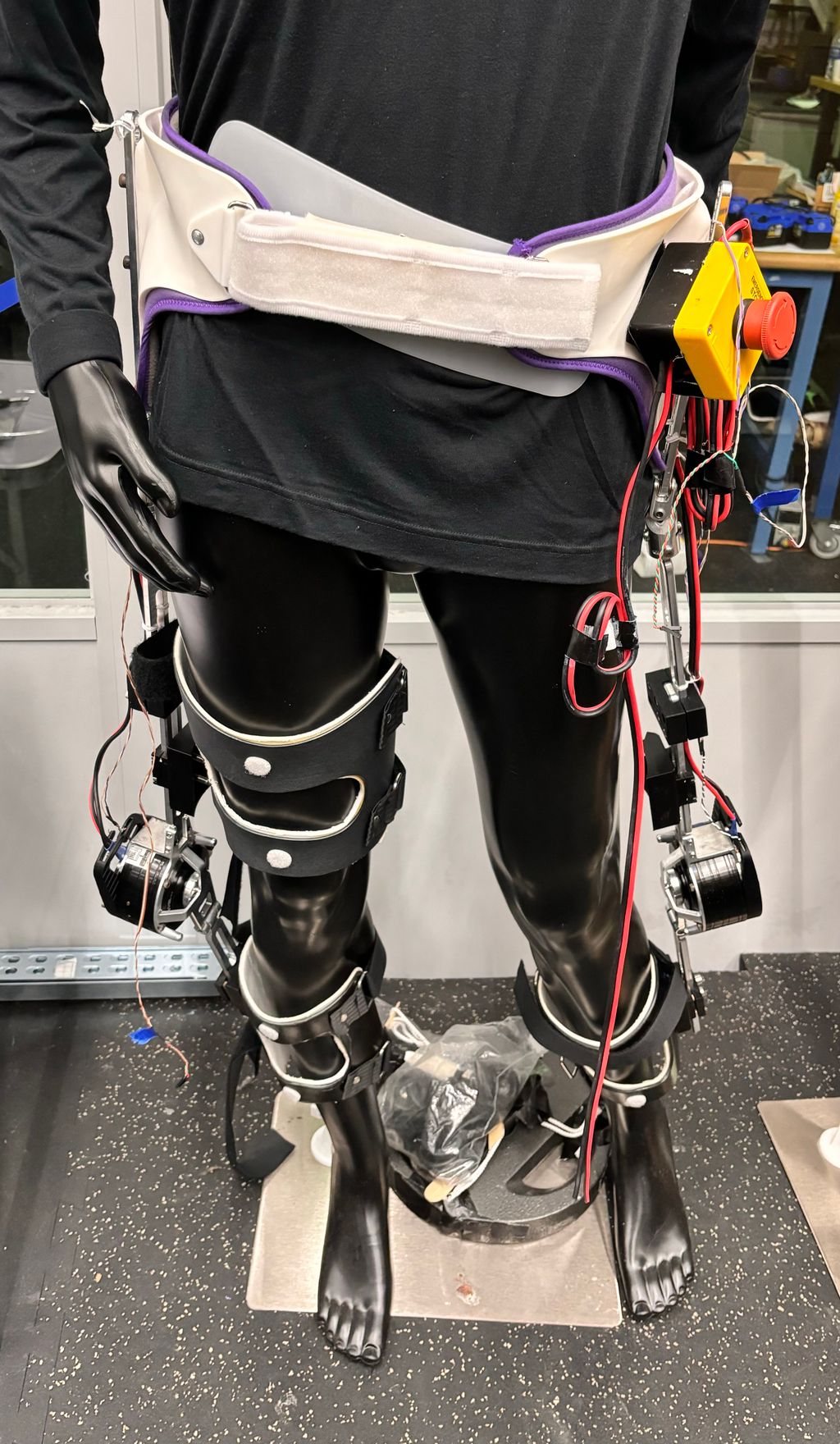
The DoE Exoskeleton Team at EPIC Lab aims to bridge the gap between rigid, high-power active assistance and ergonomic, lightweight passive assistance. Our goal is to develop back and lower-limb exoskeletons that significantly reduce user muscle fatigue during physically demanding tasks.
My work specifically addresses the GRAHAM Suit, a knee exoskeleton equipped with a sensor suit and an electronics backpack, designed to assist mobility-impaired individuals and preserve their independence.
System Architecture
Background on Controller Architecture
We implemented a robust hierarchical control strategy to manage the complex human-robot interaction:
- Offline Learning: Training Joint Loading Estimates models using collected biomechanical data to understand user exertion profiles.
- Real-Time Control:
- High-Level: Real-time estimation of joint loading and user intent.
- Mid-Level: State Space Controller modeling the system as a spring-damper system for smooth admittance control.
- Low-Level: High-frequency PID Motor Controller for precise torque tracking.
Engineering Implementation
Hardware Design (GRAHAM Suit)
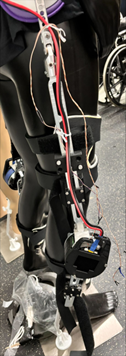
To improve the universality of the exoskeleton, I designed and manufactured new adjustable aluminum struts to accommodate users ranging from the 5th to 95th percentile in height. This modular design ensured correct joint alignment for a diverse participant pool during clinical trials.
I also overhauled the backpack's cable management system, designing custom 3D-printed wire holders and routing paths. This significantly reduced setup time and eliminated signal noise caused by loose connections during dynamic walking tasks.
Sensor Feedback & ML
Accurate state estimation relies on fusing data from multiple modalities:
1. Pressure Insoles Calibration
Currently, the lab has a scaling relationship to extract GRF from pressure insoles, however these relationships are not linear and are affected by various factors such as the user's weight. I developed a shallow machine learning pipeline to estimate Ground Reaction Forces (GRF) from pressure heatmaps to establish a more accurate relationship:
- Experimental Collection: Gathered raw pressure data from subject trials.
- Preprocessing: performed data cleaning, signal processing, and aligned collected signals with ground truth data.
- Feature Engineering: Reorganized data for ML workflows and applied feature reduction.
- Training & Validation: Trained models using the Leave-One-Subject-Out method to ensure robustness.
- Model Comparison: Evaluated Fully Convolutional Neural Networks (FCNN) versus CNNs. The CNN approach demonstrated superior performance by leveraging the spatial structure of the pressure footprint.
2. Load Cell Automation
To streamline experimental trials, I wrote Bash scripts to automate the initialization and "broadcasting" of load cell data to a ROS node, ensuring synchronization with the main control loop and making experimentation setup quicker.
Performance & Results
Through the iterative design and testing process, several key improvements and learnings were identified:
- Hardware Versatility: The shift to adjustable aluminum struts successfully met the requirement of accommodating 5th-95th percentile users, ensuring consistent joint alignment across a diverse population.
- Machine Learning Efficacy: Comparative analysis revealed that CNNs significantly outperformed FCNNs and linear scaling for GRF estimation. The learning was that preserving the spatial structure of pressure heatmaps is essential for accurate force prediction.
- Operational Efficiency: Automating the load cell initialization reduced trial setup time and guaranteed synchronization, streamlining the overall experimental workflow.