Context & Motivation
Over 500,000 Americans experience limb loss annually. Post-amputation care is critical, as fluctuations in residual limb volume can lead to improper prosthetic fit, skin breakdown, and infection. Existing solutions (shrinkers, rigid bandages) provide compression but lack real-time monitoring capabilities, forcing clinicians to rely on subjective patient feedback.
This project introduces a "Smart Shrinker" that combines traditional compression therapy with integrated sensing to track limb volume, temperature, and humidity, enabling early detection of complications like lymphedema.
Project Objectives
- Multi-Sensor Data Collection: Integrate force sensing resistors and conductive fabric to track limb dimensional changes within ±0.5 cm.
- Infection Monitoring: Detect early signs of inflammation via real-time temperature and humidity tracking.
- Wireless Telemetry: Transmit sensor data via Bluetooth to a clinical dashboard for remote monitoring.
System Architecture
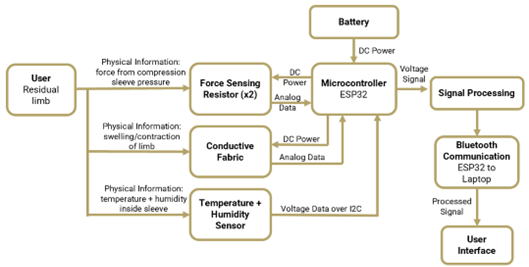
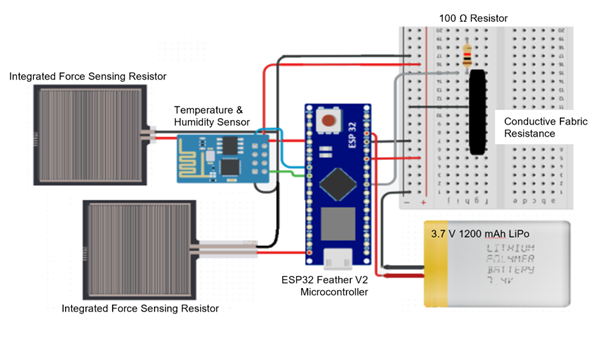
The system is built around an ESP32 microcontroller powered by a LiPo battery. It aggregates data from three distinct sensor modalities before wirelessly transmitting it to a laptop-based clinician dashboard.
Engineering Implementation
Sensing Principle: Conductive Fabric
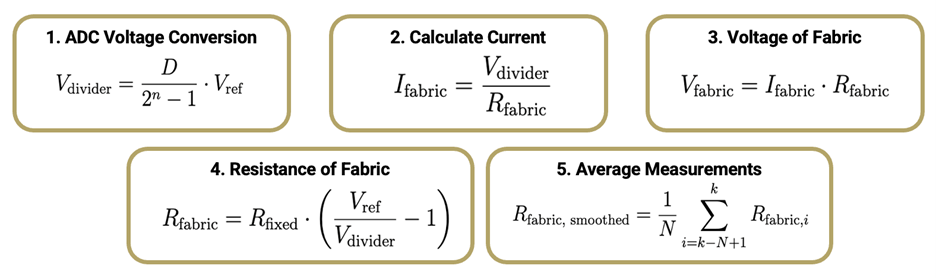
Unlike standard strain gauges, we utilized Conductive Fabric to measure limb circumference changes. As the fabric stretches, its electrical resistance changes. We implemented a voltage divider circuit to measure this resistance:
- Circuit Topology: The conductive fabric acts as the variable resistor () in series with a known reference resistor. By measuring the voltage drop, we calculate the instantaneous resistance.
- Signal Conditioning: To mitigate noise, the firmware takes the mean of 20 ADC readings over a 1-second interval before calculating the resistance.
Material Selection Study
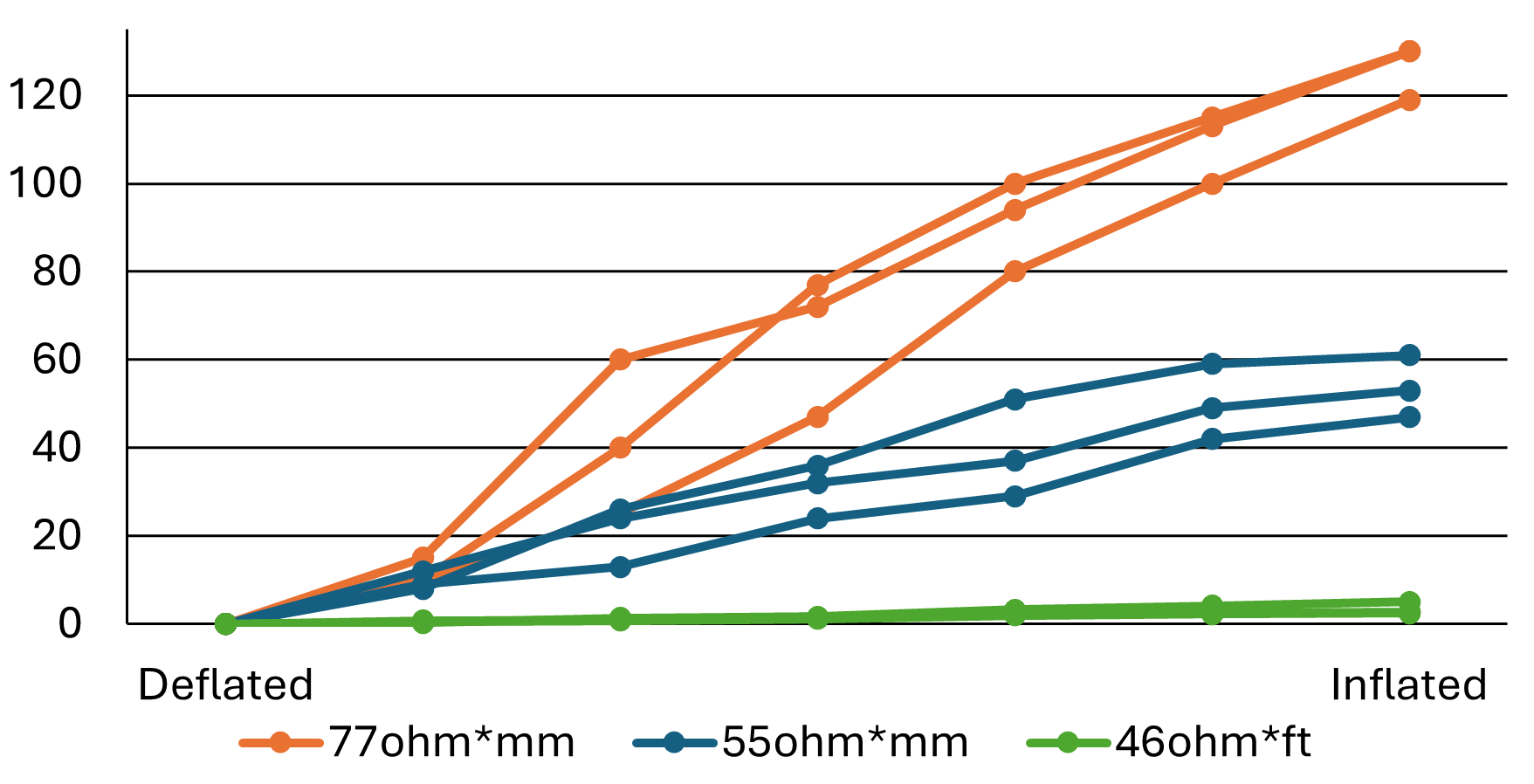
We compared three conductive fabric candidates to optimize sensitivity:
- Candidates: Sheet Texture vs. Cloth Texture with varying resistivities (55Ω, 77Ω, 46Ω).
- Result: The 77Ω Sheet Texture fabric demonstrated the highest linearity and dynamic range under stretch, making it suitable for detecting subtle limb volume changes.
Electronics & Packaging
A key design constraint was maintaining the "soft" feel of the textile while housing rigid components.
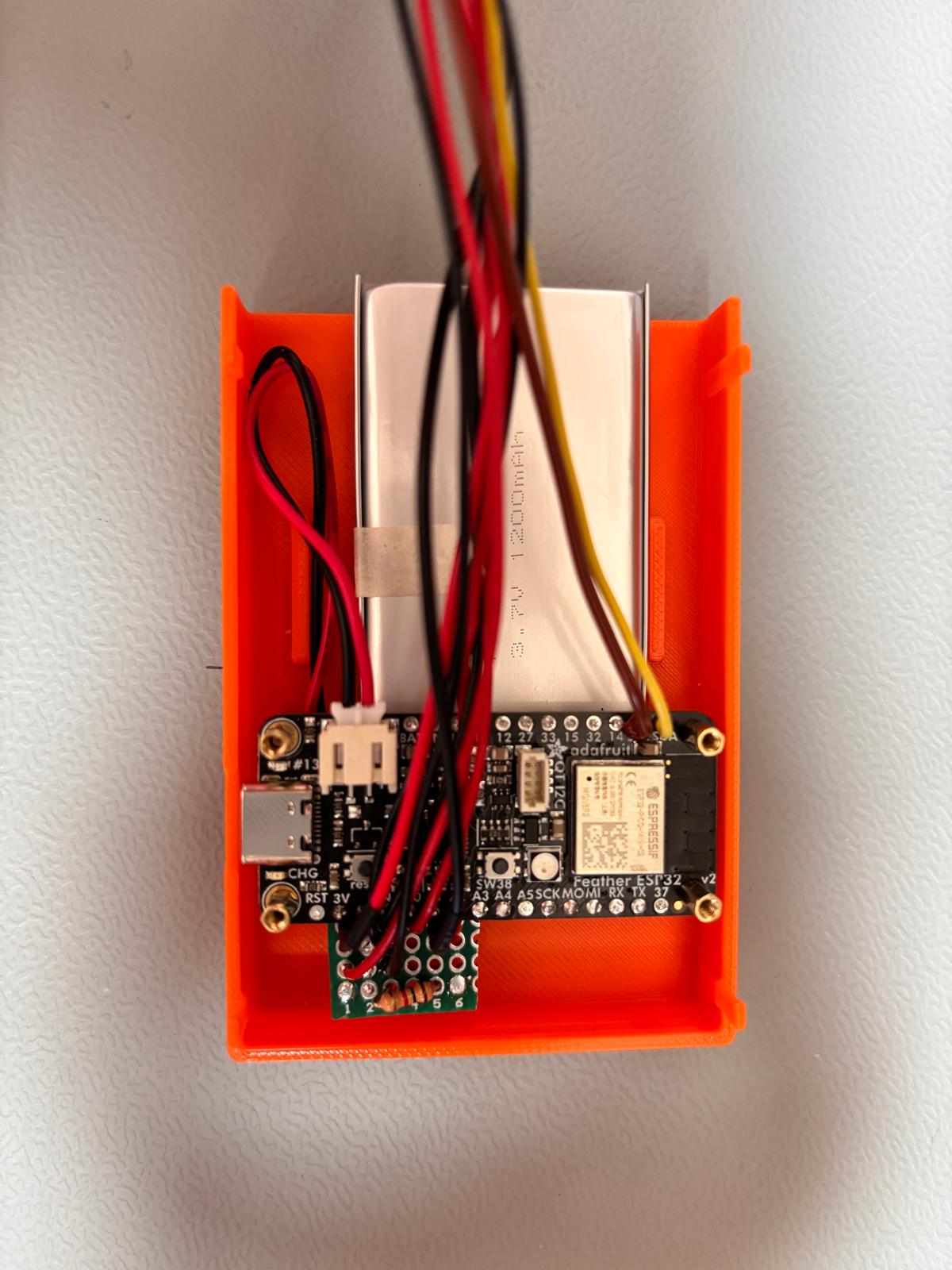
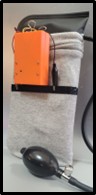
- Snap-Fit Housing: Designed a custom 3D-printed enclosure that clips onto the sleeve. It features a snap-fit lid for easy battery access and protects the ESP32 from impact during daily use.
- Safety: The system operates on low-voltage battery power with proper electrical isolation to ensure user safety during prolonged skin contact.
Testing & Validation
Simulated Limb Trials
We validated the device using an Inflatable Air Bladder to mimic the swelling and shrinking of a residual limb. This allowed us to controllably vary the circumference by < 0.5cm increments while recording sensor outputs.
Performance & Results
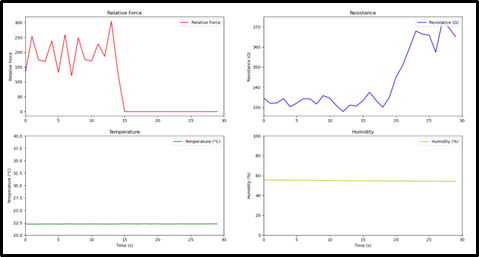
- Precision: successfully tracked limb circumference changes as small as 0.5cm in benchtop trials.
- Environmental Sensing: The DHT sensor captured humidity and temperature shifts, validated by comparing "on-body" vs. "ambient" readings.
- Connectivity: The Bluetooth link maintained a reliable stream (0.5Hz update rate) to the custom Python-based GUI for real-time visualization.